
Archives
-

JKUES, Volume 5, Issue 3 (September-30 2026)
The Journal of Karary University for Engineering and Science (JKUES) is pleased to present Volume 5, Issue 3 (September 30, 2026), featuring a diverse collection of peer-reviewed research articles that reflect ongoing advances across engineering, science, and technology. This issue brings together scholarly contributions in Chemical Science and Engineering, Aeronautical Engineering, Mathematical Science, Computer Science and Information Technology, and Surveying Engineering, highlighting the multidisciplinary scope of contemporary scientific research.
The articles presented in this issue explore a wide range of theoretical and applied research topics, addressing current scientific and engineering challenges through rigorous analysis, innovative methodologies, and practical solutions. From developments in chemical science and engineering processes to advances in aeronautical technologies, mathematical modeling and analysis, computing and information technologies, and modern surveying techniques, the issue demonstrates the important role of interdisciplinary research in supporting technological and scientific progress.
Through this multidisciplinary collection, JKUES continues its commitment to providing a platform for researchers, academics, engineers, and practitioners to communicate their findings and exchange scientific knowledge. The journal seeks to encourage collaboration across disciplines, bridge the gap between theoretical research and practical applications, and promote innovative approaches to addressing emerging challenges in engineering and science.
The Editorial Board extends its sincere appreciation to all authors for entrusting JKUES with their research and to the reviewers and editors for their valuable time, expertise, and commitment to maintaining the quality and integrity of the journal. We hope that the contributions published in this issue will stimulate further research, encourage academic collaboration, and contribute meaningfully to the advancement of engineering, science, and technology.
-
JKUES, Volume 3, Issue 3 (December-30 2024)
We are delighted to announce the release of the latest issue of the Journal of Karary University of Engineering and Science (JKUES). This issue encompasses a broad spectrum of research topics and showcases advancements in the following fields:
- Electrical Engineering
- Chemical Science and Engineering
- Surveying Engineering
- Civil Engineering
Each article in this issue reflects the dedication and hard work of researchers who are contributing significantly to the progress of engineering and science.
-

The 1st Scientific Conference for Aerospace Researches and Applications Sudan (SCARA 1)
In recent years, much progress has been made in the development of Aerospace Science and Applications. Advanced Industries Group (AIG) cooperated with Karary University to organize the first Scientific Conference for Aerospace Researches and Applications (SCARA-1) on 22-24 November 2021 sponsored by Military Industries Defense as an advance step towards regional leadership with International standards. The conference covered 12 fields related to aerospace researches and its applications.
The aims of the conference are to share knowledge and opinions between Sudanese researchers, Engineers, and Scientists in the aerospace field and its applications, so as to solve any relevant problems with available local resources and to emphasize the relationship between AIG as a military industries sector and scientific research in smart partnership with Karary University. -
JKUES, Volume 4, Issue 2 (July-30 2025)
The Journal of Karary University for Engineering and Science (JKUES) is pleased to release Volume 4, Issue 2 (July 30, 2025), presenting a diverse and carefully curated collection of peer-reviewed research articles that reflect the dynamic progress and innovative spirit in engineering and applied sciences. This issue encompasses significant contributions in Chemical Engineering, Electrical Engineering, Computer Science, and Surveying Engineering, highlighting both theoretical advancements and practical applications.
The featured studies explore innovative methodologies, novel frameworks, and emerging technologies aimed at solving real-world engineering challenges. From sustainable chemical processes and advanced electrical systems to cutting-edge computer science applications and modern surveying techniques, the research presented in this issue underscores the commitment of the scientific community to addressing contemporary engineering problems.
By publishing these contributions, JKUES continues to serve as a platform for academic dialogue, encouraging the exchange of ideas, promoting interdisciplinary collaboration, and inspiring future research. This issue not only contributes to the growing body of knowledge but also emphasizes the journal’s mission to support innovation, bridge the gap between theory and practice, and advance engineering and scientific development worldwide.
-

JKUES, Volume 2, Issue 2 (Jun-30 2022)
Many studies have investigated the crude oil separation process's separation mechanisms, size, and design, employing horizontal 3-Phase Gravity Separators in depth. There are, however, very few articles on their dynamics, modelling, and simulation. Understanding its dynamic behaviour will aid in designing and tuning the device that can manage water level, oil level, and gas pressure in response to feeding variations. This Scientific Paper gives a complete mathematical analysis, modelling, and simulation of a crude oil separation process using a horizontal 3-Phase Gravity Separator using Mathworks Matlab R2016b-x64 and Aspen Hysys V10. Bishoy's Equations, which were constructed, will assist in operating this gadget, locating various variables, and observing the effect of modifying variables on the system's variables. The rationale for this study was developed in response to the small number of articles discovered, which may be a covert issue held up by large oil companies, as well as the complicated equations related to this process that remain unsolved, and to monitor what is happening in this complex dynamic process. As a result, this Research Paper is unique and novel, and it can be compared to the work done by some authors who did not solve the obtained differential equations and did not go further in Aspen Hysys Modeling and Simulation, whereas this paper provides everything related to a three-phase gravity separator, including changing of variables and observing the effect on the system when those variables were modified. Furthermore, separators are designed with internal baffles to promote laminar flow and increase separator efficiency. However, it has been assumed that there are no baffles here, which is a significant problem, but with the help of these equations, the horizontal three-phase gravity separator can be operated at its maximum efficiency. The equations determined the following variables: The height of gas, water, oil, the height of oil when it jumped the weir, the pressure of the gas (in and out), water pressure (in and out), oil pressure (in and out), and the effect of increasing (control valve's stem position) and decreasing $ Q_{in} $ (inlet volumetric flowrate) on these variables have all been studied. This article discovered that increasing the control valve stem position and decreasing the inflow volumetric flowrate of both oil and water was highly unsafe and caused significant variations in the system's heights and pressures using Matlab. The Aspen Hysys analysis optimally separates the oil, gas, and water to determine material, energy streams properties, and compositions. As a result, this complex dynamic behaviour was observed, and no additional articles were discovered that addressed this subject. This process monitoring will determine the best conditions for flawless separation, with the selectivity of the desired product or products as the primary goal. This research can revolutionize the way people think about oil and gas extraction and processing and benefit colossal oil and gas firms in Europe, Asia, and Africa.
-

JKUES, Volume 4, Issue 4 (December 31, 2025)
The Journal of Karary University for Engineering and Science (JKUES) is pleased to present Volume 4, Issue 4, published on December 31, 2025. This issue highlights a focused collection of peer-reviewed research articles in the fields of Chemical Engineering and Electrical Engineering, reflecting the journal’s continued commitment to publishing high-quality, impactful research.
The featured articles explore a range of topics—from innovative chemical process optimization and environmental solutions to advancements in electrical systems, smart technologies, and power electronics. Each contribution offers novel insights, robust methodologies, and practical relevance, underscoring the critical role of engineering research in addressing current and emerging challenges.
This issue reaffirms JKUES’s mission to support the dissemination of scientific knowledge, foster interdisciplinary collaboration, and provide a platform for researchers, engineers, and scholars to engage with pioneering developments in their fields.
-
JKUES, Volume 2, Issue 4 (December-31 2022)
The (JKUES) provides an effective aid for the dissemination of Engineering and science researches, inspiring interdisciplinary research cooperation to solve the problems related to the engineering and science fields. The JKUES is not limited to a specific aspect of science and engineering but is instead devoted to a wide range of subfields in engineering and sciences. The journal publishes original and review articles in all engineering and science and all science disciplines, which are related to the technology trends. The survey, tutorial, and discussion papers from experts in these fields also are welcome to publish in this journal. The JKUES appears as two types; online (ISSN: 1858-8034) and print (ISSN: 1858-800X). Moreover, the JKUES will be reviewed with double-blind peer reviews, and the journal is quarterly published by year.
-
JKUES, Volume 5, Issue 2 (June-30 2026)
The Journal of Karary University for Engineering and Science (JKUES) is proud to present Volume 5, Issue 2 (June 30, 2026), featuring a distinguished collection of peer-reviewed research articles that reflect the latest advancements in engineering and applied sciences. This issue brings together high-quality contributions in Mechanical Engineering, Computer Science and Information Technology, and Surveying Engineering, demonstrating the diversity and interdisciplinary nature of contemporary engineering research.
The articles published in this issue address a broad spectrum of scientific and technological challenges through innovative methodologies, rigorous analysis, and practical applications. The research covers emerging developments in intelligent computing, software and information technologies, advanced mechanical systems, manufacturing processes, geospatial technologies, and modern surveying techniques. Collectively, these contributions provide valuable insights that support sustainable development, technological innovation, and evidence-based engineering practice.
As the field of engineering continues to evolve rapidly, JKUES remains committed to disseminating high-impact research that bridges the gap between academia and industry. By providing an international platform for researchers, engineers, and practitioners, the journal fosters scientific collaboration, encourages interdisciplinary knowledge exchange, and promotes solutions to real-world engineering challenges.
The Editorial Board extends its sincere appreciation to the authors, reviewers, and editors whose dedication and professionalism have made this issue possible. We hope that the research presented in this volume will inspire further innovation, stimulate academic discussion, and contribute to the continued advancement of engineering and scientific knowledge.
-

JKUES, Volume 3, Issue 2 (September-30 2024)
We are pleased to present the latest issue of the Journal of Karary University for Engineering and Science (JKUES), which showcases a collection of diverse and impactful research contributions. This issue brings together a wide array of studies, each representing significant advancements in their respective fields. We have carefully selected papers from key engineering and scientific disciplines, reflecting both the interdisciplinary nature of the journal and its commitment to promoting cutting-edge research.
The sections covered in this issue include:
-
Chemical Science and Engineering: Contributions in this section explore recent innovations and applications in chemical engineering processes and technologies, contributing to both theoretical advancements and practical solutions in various industrial contexts.
-
Surveying Engineering: The studies featured here address the latest techniques and methodologies in land surveying, mapping, and spatial data analysis, which play a crucial role in modern infrastructure development and management.
-
Civil Engineering: This section contains research focused on structural analysis, material engineering, and sustainable construction practices, contributing to the ongoing development of resilient and efficient civil infrastructures.
-
Computer Science and Information Technology: Papers in this category delve into areas such as algorithm development, data security, artificial intelligence, and information systems, highlighting the rapid growth and impact of digital technologies in both industry and academia.
-
Electrical Engineering: The contributions in this field address a wide range of topics, from power systems and renewable energy integration to advanced control systems and electronic devices, showcasing advancements that drive innovation in the electrical engineering industry.
We hope that the insights and discoveries presented in this issue will inspire further research and collaboration within the engineering and scientific communities. The Journal of Karary University for Engineering and Science remains committed to fostering academic excellence and providing a platform for the dissemination of pioneering research.
We would like to extend our gratitude to the authors, reviewers, and the editorial board for their hard work and dedication in making this issue possible.
-
-

JKUES, Volume 1, Issue 1 (October-31 2021)
Cover Story (view full-size image): Disassembly for end of life products considered a very important issue nowadays, to keep an environment is clean as much as possible and reduce pollution by reducing industrial waste, the disassembly line is to solve this problem, but the disassembly line is facing more problems such as smoothness of workload in workstations, hazard parts in disassembly products, etc. To optimize these problems in the disassembly line, we proposed a multi-objective ADAM optimizer algorithm to optimize and balance the objectives. An automatic disassembly line is assumed to increase disassembly processes rather than manually. The mathematical model embedded in the proposed algorithm simulated in default disassembly line, a Pareto set used to detect for non-inferior solutions in the algorithms, and the results indicated to improve the productivity of between 400% to 500%, reduced the energy consumption between 50% to 75%, reducing the number of workstations between 80% to 95%, and reduced cycle time between 70% to 85%. View this paper
-

JKUES, Volume 4, Issue 1 (March-31 2025)
This issue of the Journal of Karary University for Engineering and Science (JKUES), Volume 4, Issue 1 (March 31, 2025), presents a diverse collection of peer-reviewed research articles that reflect the ongoing advancements in various engineering disciplines. The issue features significant contributions in Chemical Engineering, Electrical Engineering, and Surveying Engineering, showcasing innovative methodologies, practical applications, and theoretical insights. These studies aim to address current challenges, propose novel solutions, and promote the exchange of knowledge within the engineering and scientific community.
-

JKUES, Volume 2, Issue 1 (March-31 2022)
This paper investigates the structural behaviour of Concrete-Filled Steel Tubular (CFST) stub columns through axial load strength. Three series distinguished were chosen depending of the steel X-sectional area of the tubes for each series of different shape are compared: circular, rectangular and square steel sections considering the parameters of the different types of concrete infill, i.e. normal strength concrete (NSC) or high strength concrete (HSC). It is found from these comparisons that all the codes (Eurocode part 4 (EC4), AISC-360-10 and BS5400-5) predicted conservative column strengths compared to the test results and published theoretical method with an average ratio (0.75 for EC4,0.656 for AISC-360-10 and 0.6 for BS5400-5). the main advantages of the ABAQUS software program are it gave closer predictions to the published experimental study results with an average ratio 0.96, simplicity and the savings in test time. circular CFST stub columns strength was higher than square CFST stub columns when compare rectangular and square in same series the column have higher area of concrete have higher strength.
-
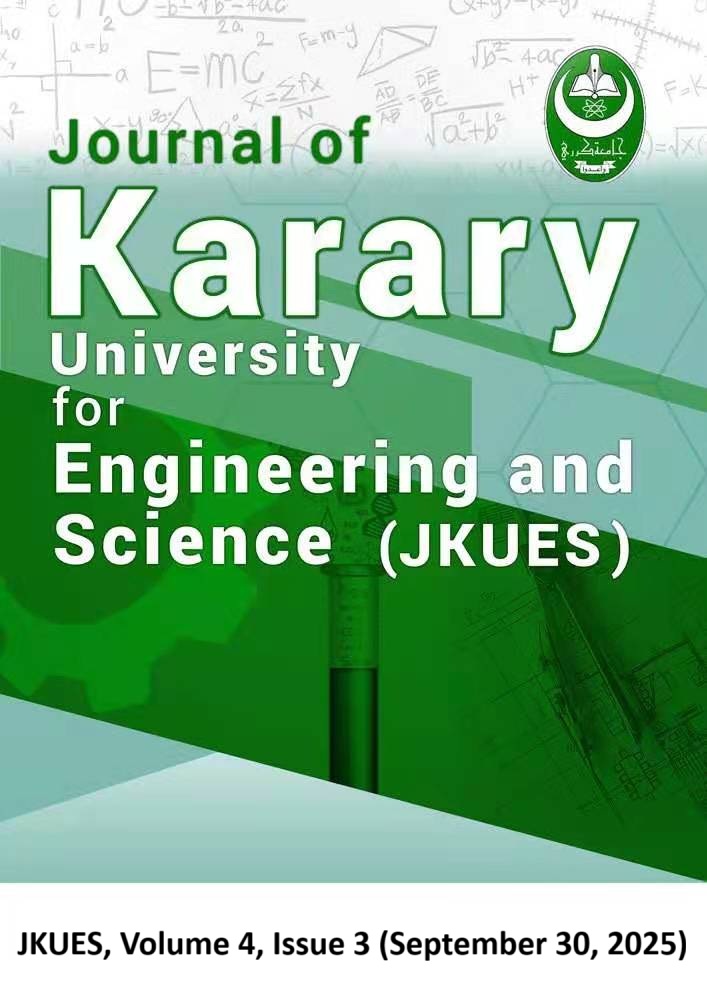
JKUES, Volume 4, Issue 3 (September 30, 2025)
The Journal of Karary University for Engineering and Science (JKUES) is delighted to present Volume 4, Issue 3 (September 30, 2025), a collection of peer-reviewed research articles that capture the latest developments across key engineering fields. This issue features significant contributions in Chemical Engineering, Electrical Engineering, Civil Engineering, and Surveying Engineering, highlighting both theoretical progress and practical applications.
The studies included in this issue address pressing challenges in their respective disciplines, offering innovative methodologies, new technologies, and impactful solutions that reflect the dynamic growth of engineering research. By bridging theory with practice, these contributions not only enrich academic dialogue but also provide valuable insights for industry and society.
As part of its mission, JKUES continues to serve as a platform for knowledge exchange, interdisciplinary collaboration, and the dissemination of pioneering research that drives engineering and scientific progress worldwide.
-

JKUES, Volume 2, Issue 3 (September-30 2022)
The disassembly line has issues with balancing the disassembly, including worker errors and the influence of these errors on worker productivity, disassembly idle time, loss of smooth work, accumulation and blockage of some work stations, and the lack of effectiveness of other work stations. In this paper, a new novel technique for balancing the waste products disassembly line is proposed, and this method depends on the machine's vision to assist workers in performing the essential tasks. The findings of comparing the performance of workers with and without assistance with the proposed method were as follows: Worker productivity increased by 50%, idle time was reduced by 77.8%, the number of workstations was reduced by 33.3%, and the error rate was reduced by 81.5%.
-

JKUES, Volume 5, Issue 1 (March 31, 2026)
The Journal of Karary University for Engineering and Science (JKUES) is pleased to present Volume 5, Issue 1 (March 31, 2026), marking a new milestone in the journal’s continued commitment to advancing scientific and engineering research. This issue features a diverse collection of peer-reviewed articles spanning Chemical Engineering, Mechanical Engineering, Computer Science and Information Technology, and Physics Science.
The contributions in this issue highlight recent developments in both theoretical and applied research, addressing contemporary challenges and presenting innovative solutions across multiple disciplines. From advancements in sustainable chemical processes and mechanical system design to emerging trends in computing technologies, information systems, and applied physics, the articles demonstrate the dynamic and interdisciplinary nature of modern scientific inquiry.
By bringing together these varied research efforts, JKUES continues to provide a platform for knowledge exchange, fostering collaboration among researchers and supporting the dissemination of impactful scientific work. This issue aims to inspire further innovation and contribute to the global progress of engineering and science.
-

JKUES, Volume 3, Issue 1 (Jun-30 2024)
Welcome to Volume 3, Issue 1 of the Journal of Karary University for Engineering and Science (JKUES)! We are delighted to present a diverse collection of original research papers that showcase the innovative and impactful work being conducted in various engineering and scientific disciplines.
In this issue, you'll find valuable contributions across multiple specialties, including:
-
Computer Science: Delve into cutting-edge advancements in artificial intelligence, data science, and cybersecurity. Our featured papers explore novel algorithms, machine learning techniques, and innovative applications that push the boundaries of technology.
-
Electrical Engineering: Discover the latest developments in power systems, electronics, and telecommunications. Our authors present groundbreaking research on renewable energy, smart grids, and electronic devices, highlighting the future of electrical engineering.
-
Chemical Engineering: Explore pioneering studies on chemical processes, materials science, and environmental engineering. This section features research on sustainable practices, new materials, and innovative solutions to pressing environmental challenges.
-
Civil Engineering: Uncover research focused on infrastructure, construction, and urban development. From smart cities to sustainable construction practices, these papers provide insights into the evolving landscape of civil engineering.
-
Mathematical Science: Engage with advanced mathematical theories and their applications in various fields. Our authors present original research on topics ranging from pure mathematics to applied mathematical models that solve real-world problems.
Each paper in this issue has undergone rigorous peer review to ensure the highest standards of quality and originality. We are proud to support the dissemination of knowledge and the advancement of science and engineering through these exceptional contributions.
We invite you to explore the innovative research presented in this issue and join us in celebrating the achievements of our authors. Thank you for your continued support of JKUES and for being part of our academic community.
-


